Validated > 99% Lab-grade Peptides
Peptide Screening: Hplc & Mass Spec Pureness Guide Apex
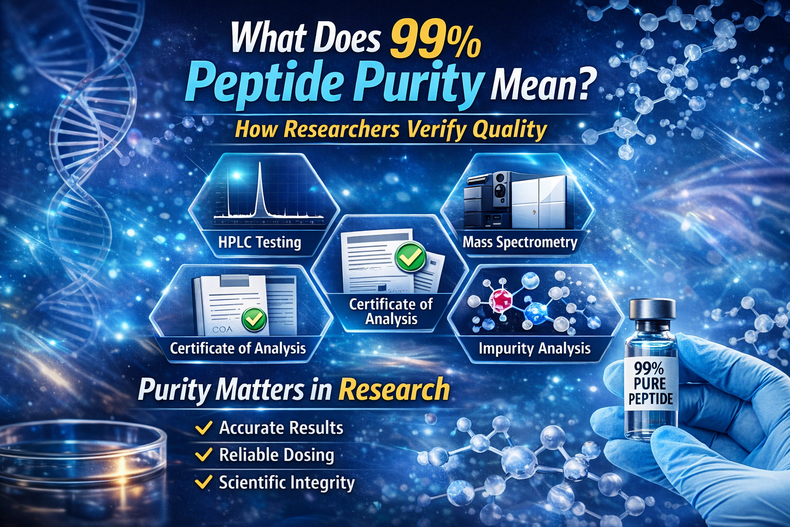
Gauging peptide purity is commonly made with analytical high-performance liquid chromatography (HPLC), typically paired with mass spectrometry (MS) for identification confirmation. These analytical methods are basic in peptide quality control and you will certainly almost always obtain HPLC and MS data with a research study peptide order. The primary logical methods for peptides include fluid chromatography (LC), generally HPLC, incorporated with mass spectrometry (MS) for precise molecular weight decision and sequence recognition.Mass Spectrometry (ms): Identification Verification

- Peptide screening is the logical process made use of to verify that a research study peptide is both pure and appropriately identified.
- Residual non-peptide elements can transform assay interpretation, misshape peptide content computations, and complicate great deal qualification.
- For example, before a peptide medication can enter human tests, its supplier must demonstrate the identification, pureness, effectiveness, and safety and security of the peptide with verified logical techniques.
Along with RP HPLC, our gifted researchers can likewise supply info on the molecular weight of peptides figured out by mass spectrometry. Matrix-assisted laser desorption ionization time-of-flight mass spectrometry (MALDI-TOF MS) and electrospray ionization mass spectrometry (ESI MS) are both most generally used methods. This article is attended to instructional and research reference functions only. All peptides sold by Pinnacle Research laboratory are desired exclusively for in-vitro research laboratory study use and are not for human intake. Peptide testing documentation should be taken batch-level logical evidence for study product, not as clinical-use permission. Pinnacle's How to Read a Peptide COA guide walks through this procedure step by step.
While peptide pureness isn't the only variable, making use of badly defined reagents is an identified contributor to irreproducible outcomes. For a 10-residue peptide with 99.5% coupling effectiveness, you would certainly expect concerning 95% of the final product to be the full-length series before purification. For a 30-residue peptide at the very same effectiveness, that goes down to approximately 86%. This is why much longer peptides are harder to create at high pureness and generally cost more. Purity is the percentage of books in the shipment that have every web page published appropriately, in the right order, with no missing out on chapters and no extra web pages stuffed in. A Peptides-UK 95% purity implies that out of every 100 "publications" in your set, 95 are excellent copies and 5 have some type of mistake.Residuals Screening
Not every application demands 99% purity, and purification is a significant component of peptide manufacturing expense. Trace amounts of solvents used during synthesis and purification-- acetonitrile, dimethylformamide (DMF), dichloromethane-- can continue to be in the end product. These are normally present at very low degrees in effectively manufactured peptides and are governed by ICH Q3C standards for appropriate limitations. If the target peptide's top make up 99.1% of the complete optimal location, the peptide is reported as 99.1% pure by HPLC. Lots of credible research peptide suppliers utilize third-party laboratories; some conduct in-house screening with magazine of research laboratory credentials.Respectable peptide providers always note their products by doing this and offer top quality reports with HPLC and MS data to back up the pureness degree. As long as you obtain peptides from a relied on source that provides a total certification of analysis, you can be positive in the peptide's purity grade and use scope. Peptides are examined with a combination of methods, consisting of HPLC for pureness, mass spectrometry (MS) for sequence verification, and nuclear magnetic resonance (NMR) for architectural analysis. These approaches help recognize the peptide's make-up, verify the molecular weight, and discover any type of architectural modifications or pollutants, ensuring the peptide satisfies high quality and spec demands. With our extensive peptide analysis platform, Imaginative Proteomics has actually created an extremely delicate and specific platform.
We employ GC-MS, ICP-MS, and other methods to detect impurities, guaranteeing item security and regulatory compliance. Peptide sequencing is crucial for identifying the precise amino acid series of peptides, including alterations like phosphorylation or acetylation. Sequencing allows researchers to recognize the organic role of the peptide and its communication with other particles, helping in the design of functional peptides for varied applications. The peptide example is dissolved in a compatible solvent and packed right into an autosampler.